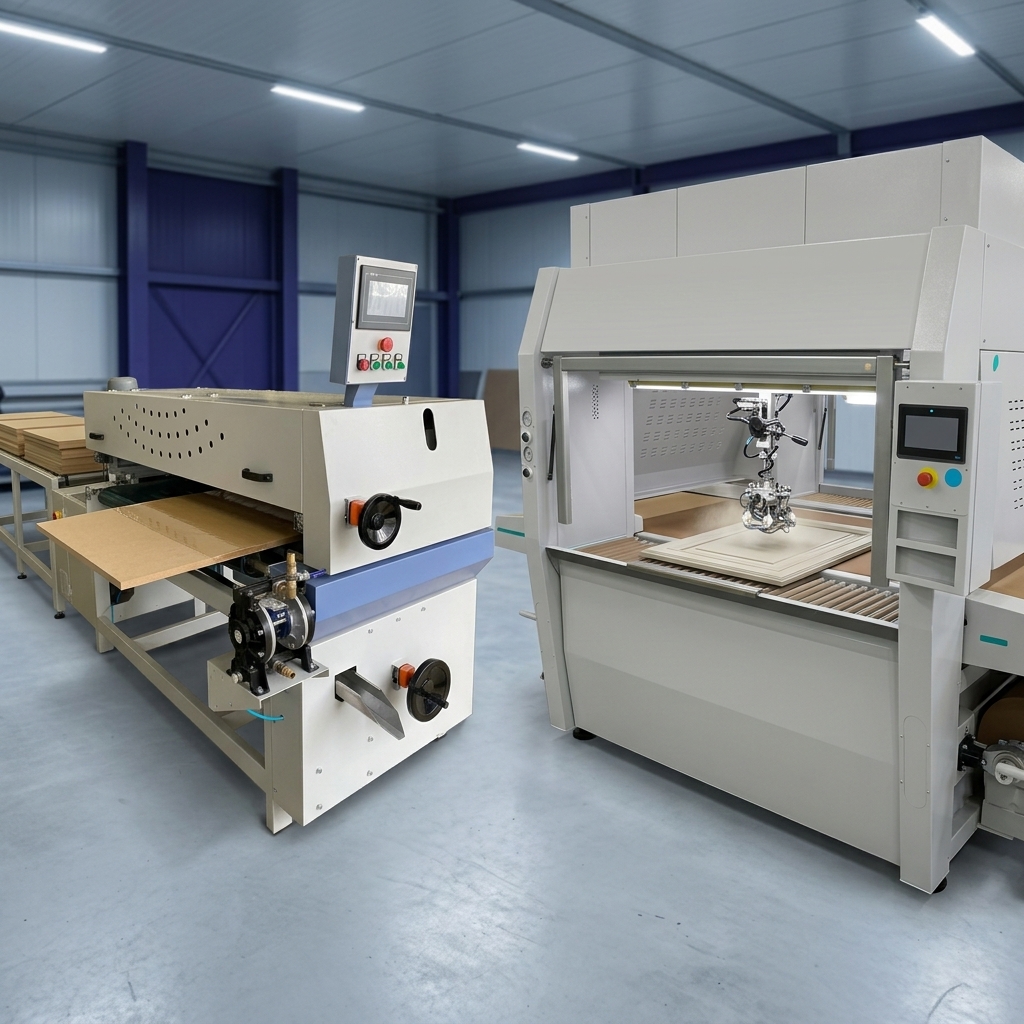
You are planning a new painting line. What you will produce is flat MDF panels: kitchen cabinet doors, cabinet back panels, decorative wall panels. There are two voices in the meeting. One says, "Get a roller coater, it's fast and clean." The other says, "Spray is more flexible, a profiled part could come in tomorrow." Neither is wrong. The right answer depends on what you produce and how much you produce.
In short: If the parts are flat and production volume is high, a roller coater is generally the more efficient route. If the parts are profiled, carved or three-dimensional, a roller cannot be used and spray is required. Some lines use both together.
How do the two methods work?
A roller coater applies paint to the surface with rollers. According to Concept UV's roller coater page, the system has a dosing roller and an application roller. The dosing roller adjusts the amount of paint transferred to the application roller. The application roller carries this paint to the panel. On the page, the application roller is listed as EPDM rubber-coated and the dosing roller as hard chrome-plated.
Spray, on the other hand, breaks the paint into fine droplets with a gun and sprays it onto the surface. No roller touches the surface. For this reason, the shape of the part does not limit the method.
This difference determines everything else.
Side by side: two methods
The figures below come from a RadTech article on wood coating. They are not measurements specific to MDF, but general wood and panel coating information. Results may vary with your own paint, machine and surface.
| Criterion | Roller coater | Spray |
|---|
| Part shape | Flat surfaces only | Flat, profiled or three-dimensional |
| Paint transfer efficiency | About 100% | Up to about 85%. Can approach 95% with recovery and suitable equipment |
| Line speed | 30–100 ft/min (about 9–30 m/min) | Up to 50 ft/min (about 15 m/min) |
| Film thickness in a single pass | About 1 mil (about 25 microns) with standard rollers; thicker with a grooved roller | 0.5–10 mil |
| Paint viscosity | Thicker, up to putty-like consistencies | Thinner (16–60 seconds in a Ford #4 cup) |
| Cleaning and maintenance | Medium | Low (on non-automatic systems) |
The takeaway from the table: on flat surfaces, the roller has the advantage in material loss and speed. Spray, on the other hand, buys you freedom of shape.
When does a roller coater make sense?
A roller coater stands out when your production is mostly flat panels.
- The paint stays inside. Because the paint travels within the roller system, there is no paint thrown into the air.
- Speed scales with the line. As long as the panel arrives flat, the rollers apply the same film again and again. The article also notes that speed is often determined by other machines in the line, such as the sander.
- Film adjustment is at the roller. In Concept UV's roller coater, the direction of the dosing roller is controlled from the panel, and the height can be adjusted manually or automatically. This means a repeatable amount of paint.
- Paint and varnish follow the same logic. The page says the unit is designed for applying paint and varnish to flat surfaces.
There is a point to watch as well: rollers require cleaning and replacement. Concept UV can also build the unit with a rail system. The rail makes cleaning and roller replacement easier.
When does spray make sense?
If the part is not flat, spray is considered the only option. The article states this clearly: three-dimensional parts cannot be painted with a roller.
- Profiled, carved and edge-detailed parts. A roller works by contacting the surface; it cannot reach every point of deep profiles and recesses.
- Various part sizes and shapes. Because the method does not depend on part geometry, different shapes can be painted on the same system.
- Thinner paint and thin films. Spray works with a wider range of film thickness and viscosity.
The cost: part of the paint goes into the booth instead of onto the part. Recovery equipment can reduce this, but it requires investment.
5 questions that decide the choice
- Are your parts flat? If half of them are profiled, a roller alone is not enough.
- How many panels do you paint per day? If the volume is high, the roller's speed and efficiency advantage pays off more. If the volume is low, the flexibility of spray may be more valuable.
- Which paint system do you use? Water-based, UV, primer, varnish. Roller settings and paint viscosity depend on this choice. The Concept UV page also states that the roller structure and process settings vary according to the coating material and the surface.
- Are the edges and the back surface painted too? If the edges and back surface will also be painted, this can affect the choice of method.
- Who can you assign to cleaning and maintenance, and for how long? Roller replacement, and filter and booth cleaning in spray, bring different workloads.
The answers to these questions are the first step before choosing a machine.
It doesn't have to be "either/or"
Real lines are not made up of a single method only. Concept UV's Back Panel Coating Line is a good example: on flat back panels, it applies water-based paint with a roller coater, dries it in a hot air oven, then uses a roller coater again and a UV curing unit for the UV varnish. The page also lists brush surface cleaning and preheating stages on the line.
An academic study shows a similar mix. In Hazir and Koç's 2021 MDF study, on the "roller" line the putty and primer were applied by roller, while the polyurethane topcoat was again applied by spray.
What does one study show?
Hazir and Koç painted MDF panels in two ways and tested them. In one, UV putty and primer were applied by roller. In the other, polyurethane primer was sprayed with air. The topcoat was the same polyurethane in both.
| Measurement | Roller route | Air spray route |
|---|
| Adhesion strength (average) | 2.866 MPa | 2.067 MPa |
| Dry film thickness (average) | 232.2 µm | 151.2 µm |
The authors attributed this difference not only to the method, but also to the chemistry of the paints used and to the UV primer. So it would not be correct to read it as "roller always adheres better." The study compares two complete systems. Still, it shows that the surface produced with the roller was successful under these measurement conditions.
What does Concept UV offer?
Concept UV's
Roller Coater unit is designed for applying paint and varnish to flat surfaces. According to the page, there is a PLC and touchscreen operator panel, manual or automatic height adjustment, and a rail system option for cleaning and roller replacement. For primer on wood-based panels, there is also a separate
Primer Application Unit. If UV curing is required, a
UV Curing Unit is added to the line.
Concept UV's solution pages focus on flat surfaces. To evaluate together which method suits your product, you can look at the
Project and Process Consulting page.
Conclusion
If you want flat panels, high volume and a clean line, a roller coater is a strong candidate. For profiled or three-dimensional parts, spray is required. Before deciding, write down your part shape, your daily volume and your paint system. These three pieces of information are the foundation for asking the right questions.
If you would like to think it through together for your line, reach us through the
Contact page. If you are also curious about the UV lamp side, take a look at our article
7 Pieces of Information to Have Ready Before Ordering a UV Lamp.