


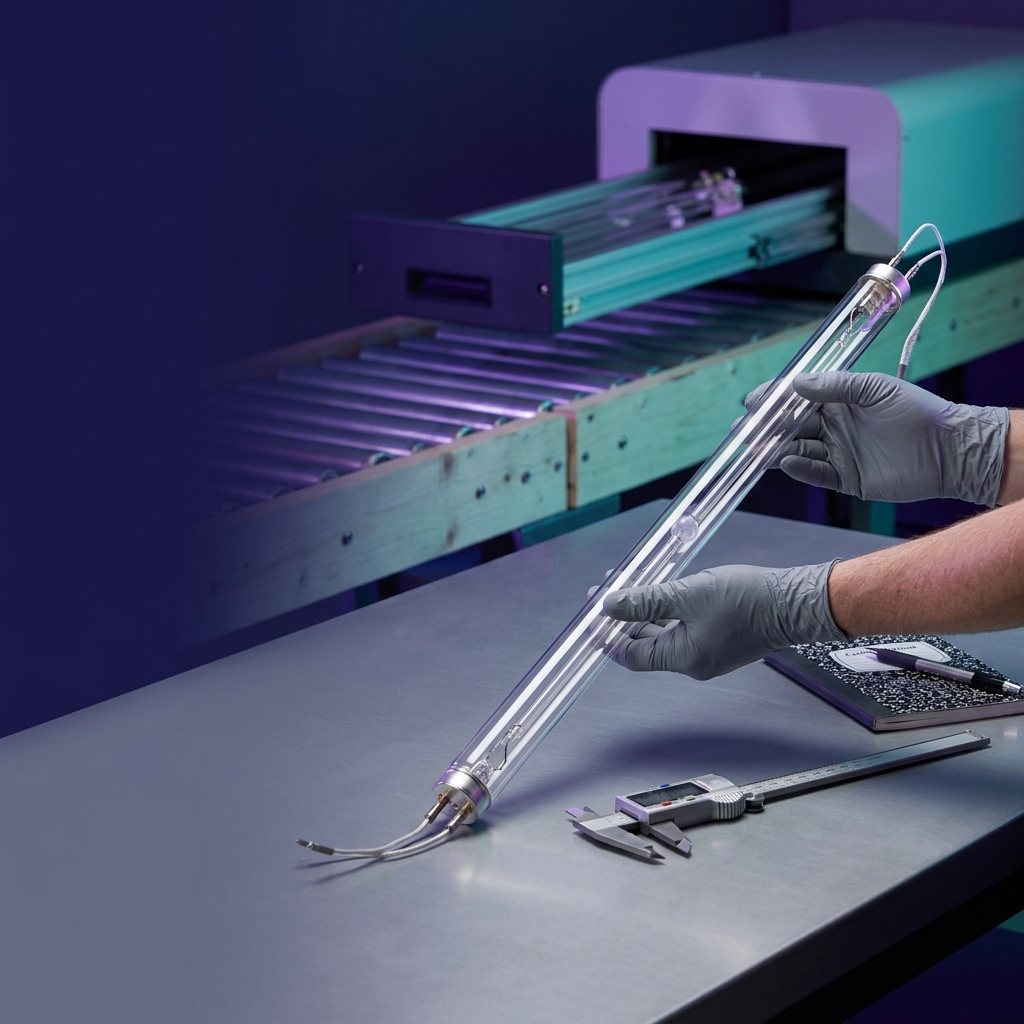
Imagine you are standing at the head of your line. The UV lamp no longer lights, or it lights but the coating no longer cures as it used to. It is clear the lamp needs to be replaced. The hard part actually begins a few minutes later: the supplier asks on the phone, "What is the arc length of your lamp, and what is the voltage?" and the label has worn off or is unreadable.
This article is for preparing before that phone call. The goal is to order the right lamp the first time.In short: - A UV lamp is not something you buy by saying "send me one"; the length, arc length, diameter and electrical values must match. - The shortest path is often this: the lamp's label, the machine model and a few photos. - The reflector, cooling and your coating determine the result as much as the lamp does; mention these in your order too.
The wrong lamp is not just a "part that doesn't fit"
Lamp manufacturers list a lamp that does not fit and inefficient UV delivery among the problems that arise when an order is placed with the wrong dimensions. The two are independent: a lamp may physically fit in place but may not give enough light at the wavelengths your coating needs. For curing, the light intensity must rise above a certain threshold at the wavelengths the photoinitiator absorbs. That is why the list answers both the question "will it fit?" and the question "will it cure?"7 pieces of information to have ready before ordering
1. Identity of the lamp and the machine
The lamp's manufacturer, model or reference number and the code on it give the fastest match. Concept UV's Spare Parts page also asks for the machine model, the name or code of the part and the label information on the product for a request. If the label has worn off, don't worry right away; the other pieces of information below are also enough to identify the lamp.2. Three basic dimensions: overall length, arc length, diameter
The overall length is the end-to-end measurement of the lamp. The arc length is the active section where the light comes from; it is shorter than the overall length. The diameter is the thickness of the glass tube. Lamp manufacturers' ordering guides ask for these three dimensions first. First cut the power, wait until the lamp has cooled and only then remove it; do not touch a hot lamp.3. Dimensions of the end caps
The metal or ceramic caps at the two ends of the lamp determine the connection. If you don't know the cap dimensions, even a clear close-up photo can help the supplier find a match. One manufacturer writes that its end caps can often be recognized from a photo.4. Electrical values: lamp voltage, current and power
A common mistake here is writing the system's voltage. What is needed is the lamp's own voltage and current. Even if two lamps are the same length, their power density (W/cm) can differ; one manufacturer states that it offers options between 80 and 550 W/cm in custom lamps. The lamp must operate with a suitable ballast and cooling; one manufacturer states that it is not responsible for damage caused by an unsuitable ballast.5. Lamp type and spectrum
Mercury lamps produce a broad line spectrum; the metal halide added inside (for example gallium or iron) shifts or broadens this spectrum. One lamp manufacturer also distinguishes standard (high output in UVA, UVB and UVC), ozone-reducing (low UVC) and high-performance (high UVC) types. You can find out which one suits you from the technical data of the company supplying the coating. Concept UV's UV Curing Unit works with mercury or gallium-doped lamp options.6. Reflector and cooling arrangement
The reflector directs the light coming from the lamp onto the surface; one lamp manufacturer states that reflectors carry up to 70 percent of the UV output to the surface. When requesting a new one, information such as length, width, thickness, material (usually aluminum or quartz) and curve shape (quarter moon, eyebrow, half moon) is required. Cooling is just as important: is it air-cooled or water-cooled? Concept UV's UV Curing Unit comes with an air-cooled structure and a replaceable reflector.7. Line and coating information, the lamp's operating hours
Which coating are you curing, at what speed, with how many lamps? Two measures determine the curing result: light intensity (W/cm²) and total energy, that is, the dose (J/cm²). According to a curing equipment manufacturer, the dose determines the maximum line speed; as the lamp ages, the light intensity also drops. For the life of mercury lamps, sources give a rough value of 1,000–2,000 hours; note how many hours your lamp has run. Color change, flickering or failure to strike are signs that it is time to replace the lamp. If you have a radiometer, add the last measurement value; these devices measure UV energy and peak light intensity. TIP: If you use an LED UV module, the list changes. There it is a module rather than a lamp; wavelength, module size and cooling type come to the fore.5 minutes of preparation before throwing away the old lamp
- Before removing the lamp, cut the power and wait for it to cool.
- Photograph the label and the two end caps up close.
- Measure and write down the overall length, arc length and diameter.
- Briefly note the lamp type, the operating hours and your curing problem.
- Do not hold the new lamp with bare hands; skin salts can affect the quartz and shorten the lamp's life. Use gloves.
Checklist at a glance
| # | Information | Where to find it | Why it is needed |
|---|---|---|---|
| 1 | Lamp and machine identity | Lamp label, machine plate | Fast matching |
| 2 | Overall length, arc length, diameter | Measure the lamp | Physical fit |
| 3 | End cap dimensions | Measurement or close-up photo | Connection compatibility |
| 4 | Lamp voltage, current, power | Label, ballast/panel information | Safe operation, correct power |
| 5 | Lamp type and spectrum | Current lamp, coating technical data | Ability to cure the coating |
| 6 | Reflector and cooling | Measurement on the unit | Light direction, lamp life |
| 7 | Line speed, coating, operating hours | Your line records, radiometer | Correct dose and replacement time |