


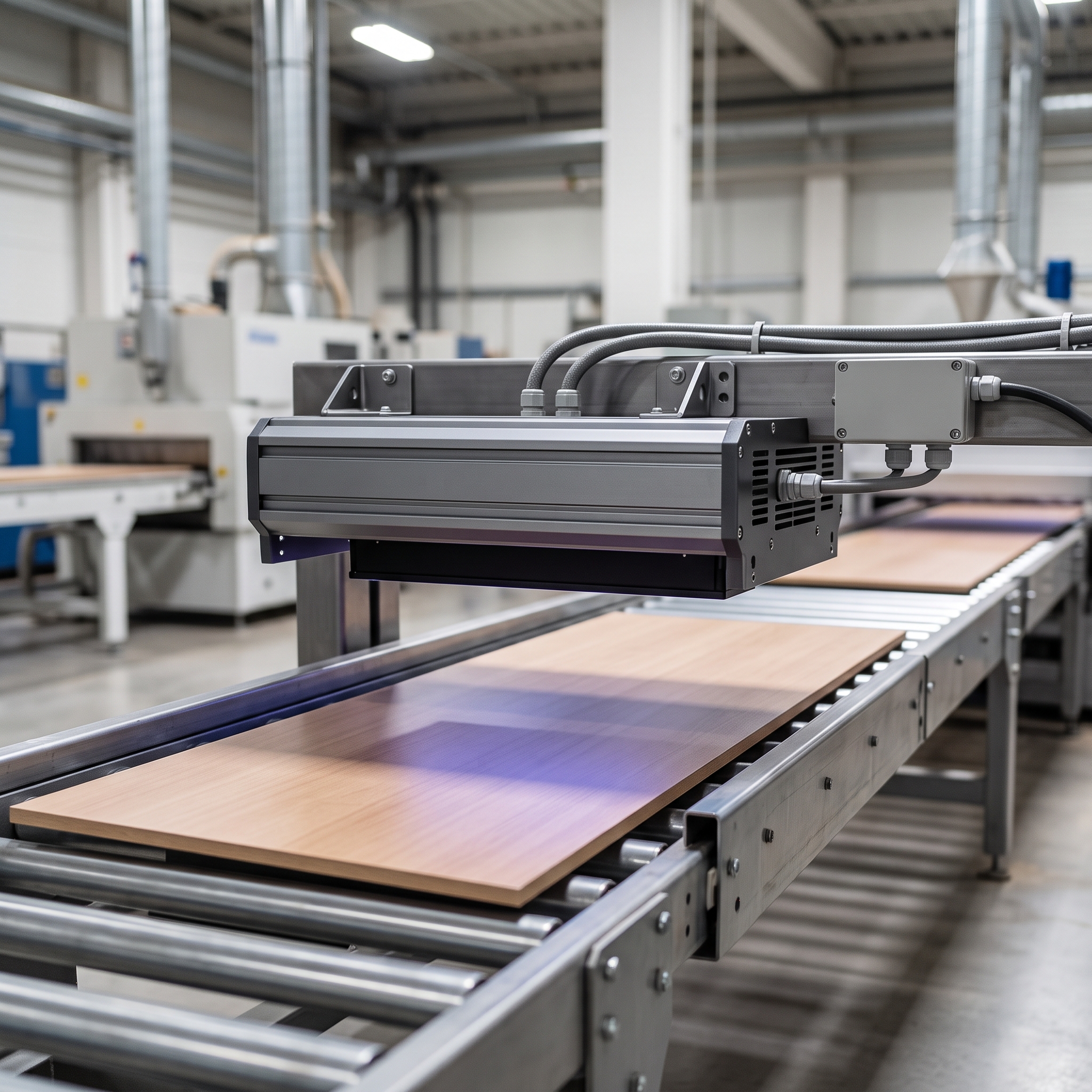
On a UV coating line, the question "which lacquer?" is now joined by another: "what will we cure it with?" Mercury lamps have been at the heart of lines for years. Now LED UV is on the table as a serious alternative, both for the energy bill and for the maintenance schedule. But here is the interesting part: the most common solution in the industry is not "either LED or mercury," but hybrid lines that use both on the same line.
Why? In this article we explain it in plain language. At the end, you will find 5 questions to ask yourself about your own line. In short:- LED UV: emits light in a narrow band; offers lower energy use, long lamp life, instant on/off and less heat.
- Mercury UV: emits broad-spectrum light; still strong in surface curing and on the topcoat, and most existing coatings were developed for this light.
- Hybrid line: takes the advantages of LED while keeping mercury where it is really needed.
Two lamps, two different lights
Think of a mercury lamp as a wide orchestra: it plays UVA, UVB and UVC light, visible light and infrared all at once. LED, on the other hand, is a single instrument: it usually emits light in a narrow band around 365, 385, 395 or 405 nanometers. This difference matters because UV coatings have been formulated for many years around the broad spectrum of mercury. In other words, LED is not a part that can be swapped one-to-one for a mercury lamp; it is a system in which the coating, the light and the line need to be considered together.Four standout advantages of LED
1. Energy. A study on furniture lines states that LEDs use 50–75 percent less energy than equivalent mercury lamps. On a furniture line installed in Europe, a saving of 55 percent was projected according to the equipment supplier's calculation. The figures vary by line, but the direction is clear. 2. Lamp life. Mercury lamps are typically rated at around 1,000–2,000 hours; in industrial LED arrays this figure can reach 10,000–25,000 hours. A line running two shifts a day operates its lamps for about 4,000 hours a year; a 1,500-hour mercury lamp would be replaced 2–3 times a year on such a line. There is also a subtle point: LEDs age too and lose output over time, so light intensity needs to be measured. 3. Instant on/off. Mercury lamps need a few minutes to become ready for operation; for this reason, in some systems, when the line stops the lamp is not switched off but its power is reduced and the shutter closes. With LED there is no warm-up wait. 4. Less heat. A mercury lamp gives off a significant part of its energy as heat; LED produces very little infrared. If you work with heat-sensitive surfaces, this difference is big. For example, on resinous woods and on lines where there is a risk of the edge banding adhesive melting, low temperature is a serious advantage.So why hasn't everyone switched completely to LED?
Because there are two real obstacles. Surface curing. Oxygen in the air can inhibit curing at the very top surface of the coating. The result can be a film that is fully cured underneath but slightly tacky on the surface. With LED, this problem needs particular attention; the solution can be proper formulation of the coating, high light intensity, a nitrogen atmosphere or a hybrid design. Coating compatibility. Most existing coatings were developed for mercury lamps. When switching to LED, an LED-compatible coating is often required. Especially in topcoat lacquers, where expectations for resistance and color accuracy are high, LED-compatible and competitively priced coatings are not yet available everywhere.Hybrid line: combining the strengths of two technologies
In a hybrid line, LED is used at some stations and mercury lamps at others. A common arrangement in the industry is as follows:- Filler, primer and base coats: Cured with LED. The longer wavelength can penetrate deeper in thick coats, and the soft gelling of LED can make bonding with the next coat easier.
- Topcoat: Cured with a mercury lamp. This is the coat with the highest expectations for surface curing and resistance.
| Mercury UV lamp | LED UV | |
|---|---|---|
| Light structure | Broad spectrum (UVA, UVB, UVC + visible + infrared) | Narrow band (usually 365–405 nm) |
| Heat | Higher | Much lower |
| Energy | Reference | About 50–75% less than an equivalent mercury lamp |
| Typical lamp life | 1,000–2,000 hours | 10,000–25,000 hours |
| On/off | Time is needed to reach full power | Instant |
| Surface curing | Strong | Needs care (oxygen inhibition) |
| Coating | Most existing coatings are made for this light | LED-compatible coating required |
How is this solved at Concept UV?
Concept UV offers both options. The UV Curing Unit can be configured with mercury or gallium-doped lamp options; the operation and power setting of each lamp are managed independently, and when the system stops, a pneumatic shutter engages and reduces the lamp power to the minimum. The LED UV Curing Unit, on the other hand, is for UV-curable coatings; it works with air or liquid cooling options and LED heads that can be integrated into a machine or an existing line. What is more, UV, LED or IR curing options can be considered for each coat on the lines. For this reason, the answer to "which lamp?" is not a single product, but what your line needs at which coat. Concept UV evaluates this choice together with the spectral requirements of the coating material, the surface to be processed and the production flow.Before deciding, ask yourself: 5 questions
- Which coating do you use? Is it LED-compatible? Do not decide without asking your lacquer supplier.
- Is your surface heat-sensitive? If it is, the low heat of LED may be the deciding factor.
- Which coats have which needs? Filler and primer do not carry the same expectations as the topcoat; this is exactly where a hybrid arrangement makes sense.
- How many hours a day does your line run? As operating hours increase, the difference in energy and lamp replacement grows.
- Do you sell your products to Europe? The RoHS exemption for mercury UV lamps in the European Union is valid until 24 February 2027. This date is not a ban, but the date by which the exemption will be re-evaluated. In the previous three reviews (2011, 2016, 2021) the exemption was renewed; according to sources, the new decision is expected at the end of 2026 or the beginning of 2027. If you export, it is worth following this development.